Our First 1,000 Coins — and the Ones We Refused to Score
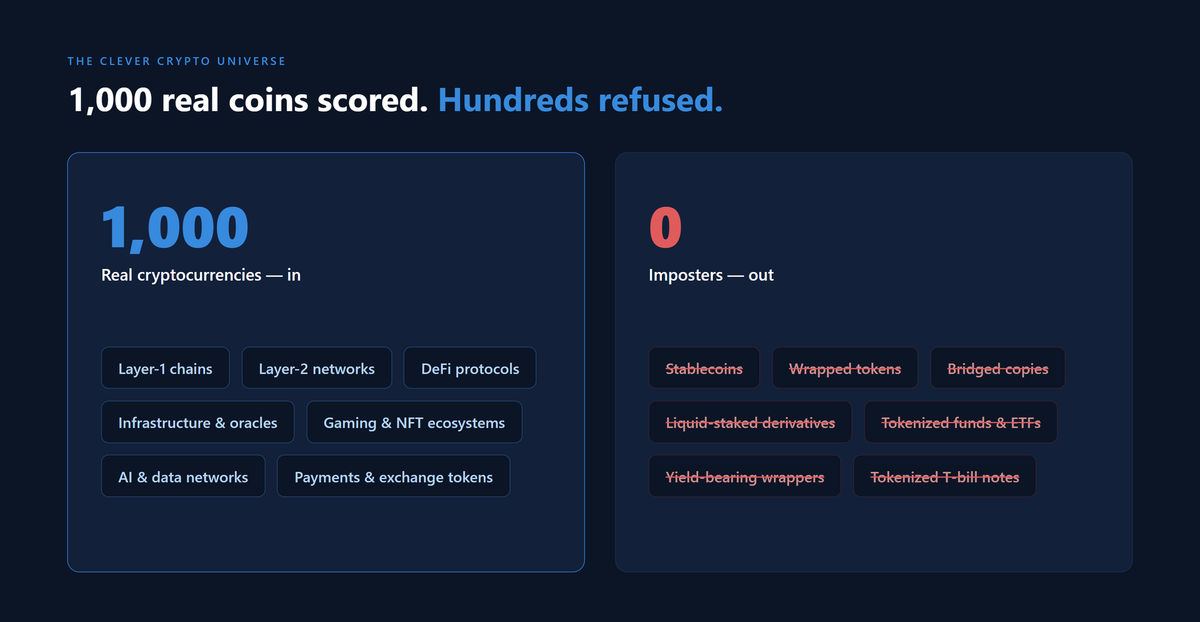
Hundreds of the biggest "cryptocurrencies" by market cap aren't coins at all. Here's what we kicked out of our universe, why it matters for every score we publish — and what's coming next.
When we say Clever Crypto scores 1,000 cryptocurrencies, there's a decision hiding inside that sentence that shapes every score we publish: which 1,000?
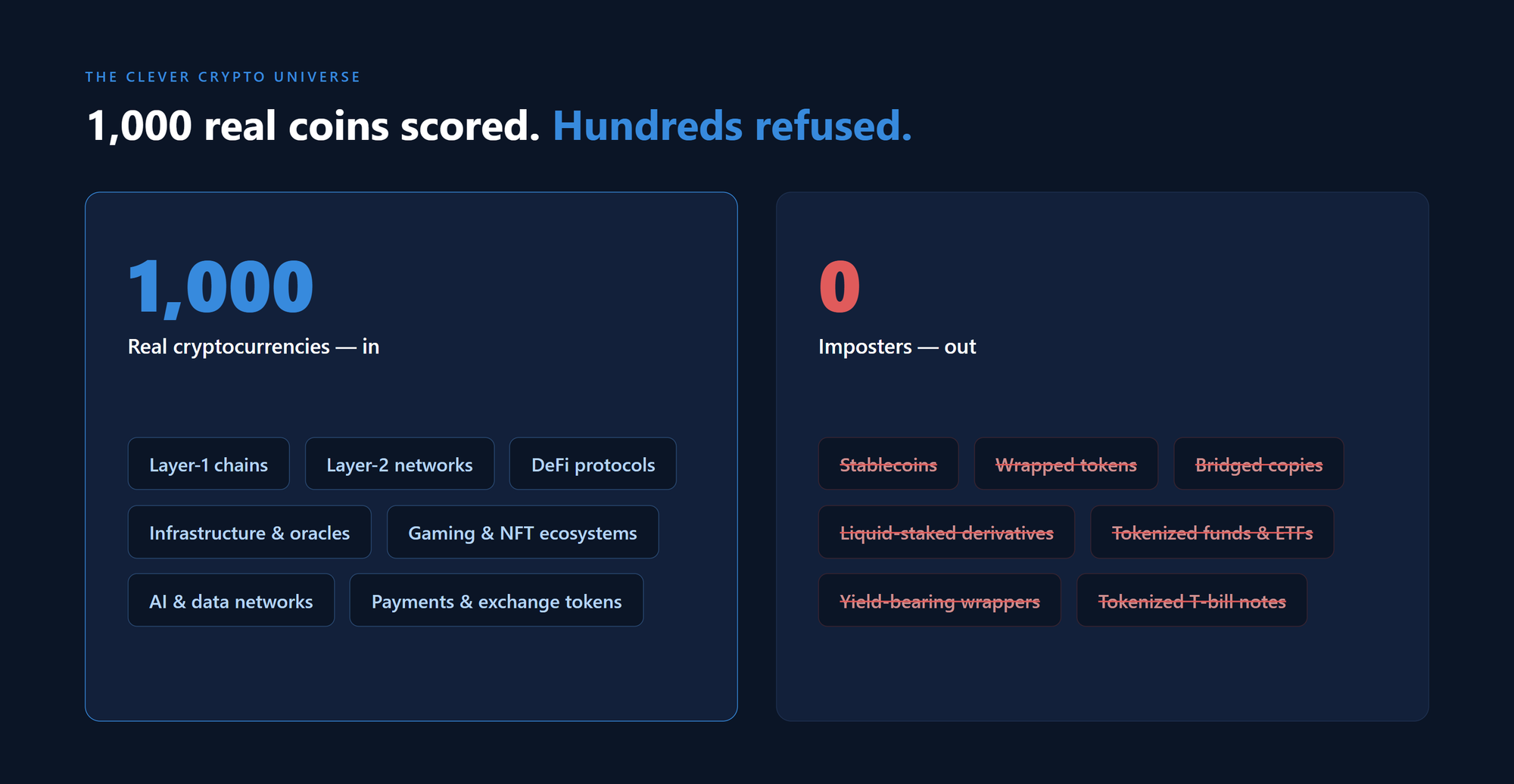
Scroll any market-cap ranking and you'll find that a surprising share of the "top coins" aren't coins at all. They're wrappers, copies, receipts, and funds wearing a ticker. We refuse to score them — hundreds of assets, filtered by 24 automated category rules plus a hand-curated exclusion list. Here's the reasoning.
What got cut, and why
Stablecoins. A stablecoin's whole job is to be worth a dollar. Momentum, tokenomics, relative strength — every question our score asks is meaningless for an asset engineered not to move. Scoring USDT a "52" would tell you nothing except that we weren't paying attention.
Wrapped and bridged tokens. Wrapped Bitcoin is Bitcoin in a raincoat. Its price is Bitcoin's, its fundamentals are Bitcoin's — but its risks are its own: a custodian, a bridge contract, a redemption promise. A score would inherit all of Bitcoin's strengths while hiding the one thing that actually distinguishes the wrapper. That's worse than no score.
Liquid-staked derivatives. Staked ETH receipts and their cousins are claims on an underlying asset plus a protocol's staking mechanics. Same problem as wrappers: the score would just be a blurry photocopy of the underlying coin's score.
Tokenized funds, ETFs, and T-bill notes. This category is exploding — money-market funds, treasury notes, and index products issued on-chain by very traditional asset managers. Fine products. Not cryptocurrencies. A tokenized T-bill graded on "developer activity" and "whale movement" is a category error dressed up as analysis.
Why purity is a scoring issue, not a tidiness issue
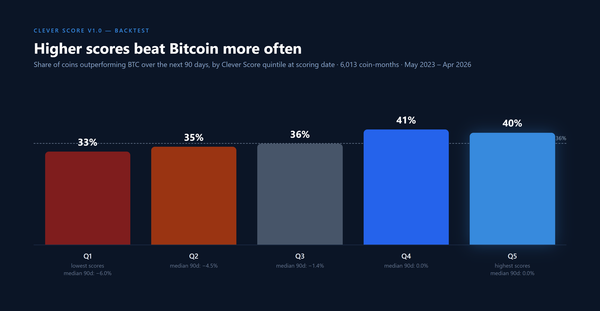
This matters beyond the assets themselves, because several Clever Score factors are cross-sectional — they rank a coin against its peers. Weekly Momentum Rank compares every coin's risk-adjusted momentum to the whole universe. Relative Strength vs Sector compares a coin to its sector's average.
Rankings are only as honest as the pool. Let 50 stablecoins into a momentum ranking and every real coin's percentile gets inflated by beating assets that were never trying to move. Let a wrapped Bitcoin into the Layer-1 sector and the sector average becomes an echo. One counterfeit in the lineup and every comparison is quietly corrupted. Cutting the imposters isn't housekeeping — it's what makes the other 1,000 scores mean something.
The filter runs forever, not once
New wrappers and tokenized funds launch constantly, and some climb the rankings fast. Our exclusion rules run automatically on every refresh cycle, and when something novel slips past the category filters — and occasionally something does — it gets reviewed and added to the manual list. The universe stays clean because cleaning it is part of the pipeline, not a launch-day chore.
More coins are coming
1,000 is where we are, not where we stop. Every coin we add starts accumulating score history from day one — and history powers some of our best factors, like Clever Score Momentum, which tracks whether a coin's fundamentals are improving. That's why we expanded the universe ahead of our launch rather than after: the coins we add today will have months of history behind their scores when you need them.
As data coverage deepens — more chains, more on-chain sources — the universe grows with it. Same rules apply to coin #1,001 as to coin #1: it has to be a real cryptocurrency, with its own economics, standing on its own data. If it's a wrapper around something else, it doesn't get a score.
Want to see what made the cut? All 1,000 are live right now — launch the app, or read how the score works.